
Stop Using AI Like Google. Start Using It Like a Chief of Staff
The context file that saved my client 12 hours per week on strategic decisions. | Institutionalise Your Executive Judgment Inside AI.

The context file that saved my client 12 hours per week on strategic decisions. | Institutionalise Your Executive Judgment Inside AI.
The Problem
You open ChatGPT. You type “Help me with my AI (or whatever is keeping you up at night) strategy.”
It gives you the same generic framework it gave 10,000 other people.
Result? You’re still stalling on decisions that should have taken three days.
AI has the capability. You know it works for other people, but you’re not getting the breakthrough you expected or need.
Why? Because AI doesn’t know your metrics, your stakeholders, or your constraints. So it gives you perfectly reasonable answers that don’t account for the fact that your CFO cares about cash flow, your board is risk-averse, the new executive on the team wants your job, and your biggest competitor just changed pricing models.
Generic AI gives you management consultant answers. Context-aware AI gives you your answers.
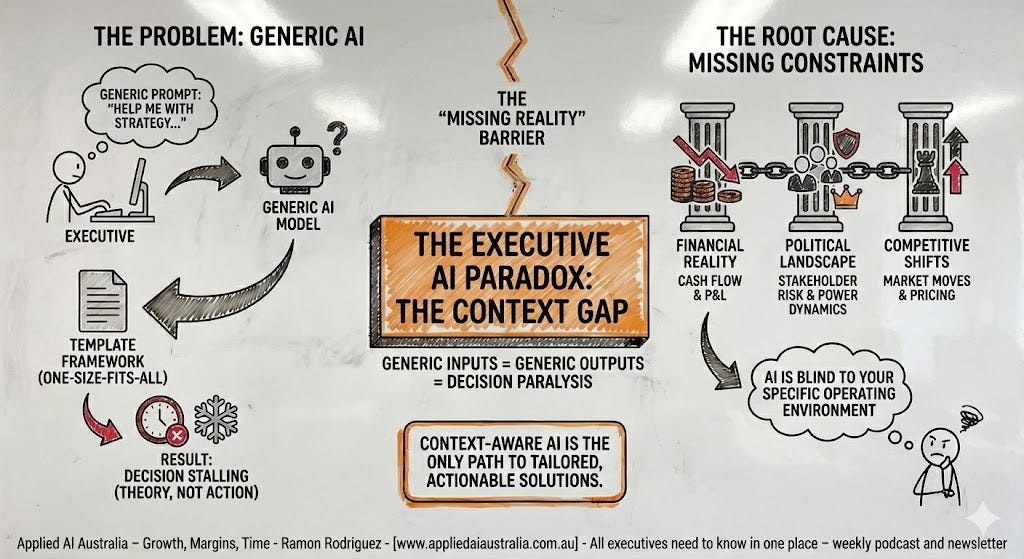
The Gap Isn’t Technical. It’s Contextual.
I watched a Melbourne CFO manage a $180M portfolio. Strategic analysis used to take three weeks: pulling reports, chasing stakeholders, building financial models, briefing the board.
We tried the standard way first. “Analyse this market opportunity.” Generic output. Useless.
Then we uploaded this specific file.
Time saved on strategic analysis: 12 hours per week. That’s 1.2 FTE at exec salary, roughly $15,000 per month in recaptured capacity.
Decisions that used to take weeks now take two days. Same quality. Better risk assessment. Faster execution.
The Fix
Context files are instruction sets. Build once. Reference every time.
Think of it like onboarding a new Chief of Staff. Except this one remembers everything, never leaves, and costs $20/month instead of $180K/year.
How This Works: Four prompts. Copy into ChatGPT, Claude, or Gemini. AI interviews you, builds documents, saves for reference.
Start with Operating Principles and Executive Context.
01 - Operating Principles
☑ COPY AND PASTE THIS ENTIRE PROMPT
I need you to help me document my Operating Principles—the rules and frameworks that govern how I work. This becomes a foundational reference.

Interview me with specific questions. Push past vague answers.

After our conversation, create an Operating Principles document.

Core Principles:
• What are the 3-5 principles I'd defend even when it costs me?
• What principle do I hold that contradicts conventional wisdom?
• What do I judge other executives for?

Decision Frameworks:
• What framework do I use when priorities compete?
• What's my risk tolerance in specific dollar terms?
• When speed, quality, and cost conflict, which breaks first?

Trade-offs:
• What trade-off do I make consistently that others might not?
• What am I willing to sacrifice for growth? For margins?

Deal-breakers:
• What ends a conversation immediately?
• What behaviour from my team is non-negotiable?

The Uncomfortable Ones:
• Where does my stated principle conflict with actual behaviour?
• What would my harshest critic say about my principles?

Start the interview now.
02 — Executive Context
☑ COPY AND PASTE THIS ENTIRE PROMPT
I need you to understand my executive operating environment—role mechanics, stakeholders, metrics, decision framework. This becomes foundational for business advice.

Interview me. Push for specifics. Create an Executive Context document.

Role Definition:
• What's my scope? What do I own versus influence?
• What's my reporting structure, team size, budget authority?
• What informal power dynamics shape my role?

Performance Metrics:
• What 3-5 numbers determine my bonus and job security?
• What's current performance against targets?
• What's the gap that keeps me up at night?

Stakeholder Landscape:
• Who can kill my initiatives? Who can make them happen?
• What does each key stakeholder care about?
• What do they value in recommendations?

Decision Framework:
• What's my risk tolerance in dollar terms?
• What's my time horizon—quarterly or multi-year?
• What's my trade-off hierarchy (speed/quality/cost)?

Resource Reality:
• What budget and headcount can I control?
• What constraints limit my options?
• What leverage am I underusing?

Business Context:
• What does my company do?
• What's our business model and competitive position?
• What market trends affect my decisions?

Begin the interview now.
03 — Career Track Record
☑ COPY AND PASTE THIS ENTIRE PROMPT
I need you to understand my career track record—what I've built, what failed, what shaped how I operate.

Interview me. Create a Career Track Record document.

Key Roles:
• What roles have I held and how long in each?
• What major projects succeeded? What metrics improved?
• What initiatives failed? What did I learn?

Capabilities:
• What am I measurably better at than most at my level?
• What do colleagues consistently ask me for?

Hard Lessons:
• What failure changed how I operate?
• What pattern do I notice across my career?
• What would I do differently if starting over?

Begin the interview now.
04 — 2026 Goals
☑ COPY AND PASTE THIS ENTIRE PROMPT
I need you to understand what I'm trying to accomplish in 2026—real goals with specific outcomes.

Interview me. Push past vague intentions. Create a 2026 Goals document.

Big Picture:
• If 2026 goes well, what's different by December?
• What would make this year a success versus failure?

Professional Goals:
• What are my top 1-3 professional goals?
• What specific outcomes indicate success?
• What needs to happen Q1? Q2? Q3? Q4?

Financial Goals:
• What are my financial targets?
• What would financial success look like?

Real Priorities:
• If I could only accomplish ONE thing, what would it be?
• What's on my list that I don't actually care about?
• What goal scares me enough that I'm avoiding it?

Obstacles:
• What's most likely to derail me?
• What blocked my goals last year?
• What will I need to decline?

Begin the interview now.
How to Use
Save Each Interview: After completing each prompt, export the conversation to PDF or copy into a private Notion page.
Reference Before Significant Work:
“Review my Executive Context and Operating Principles before we begin this vendor analysis.”
Update Quarterly: What’s different? What’s outdated? Your role changes. Your context should too.
Stack Contexts: Career decision affecting strategic positioning? Reference Career Track Record + 2026 Goals + Executive Context.
What I’m Telling Clients
Four steps. Execute in 48 hours.
Step 1: Start with Operating Principles. This takes 20 minutes. Upload the output to a private ChatGPT project titled “Executive Context.”
Step 2: Add Executive Context next. Another 20 minutes. Now AI understands your role, metrics, stakeholders.
Step 3: Test with three real decisions. Before you trust it, run three actual strategic calls through it. Compare output quality. If it’s generic, your context is too vague.
Step 4: Quarterly review. Context changes. Update every 90 days or after major role shifts.
Governance rule: If output makes you uncomfortable because it’s accurate, you built it right. If output is safe and generic, rebuild with harder truths.
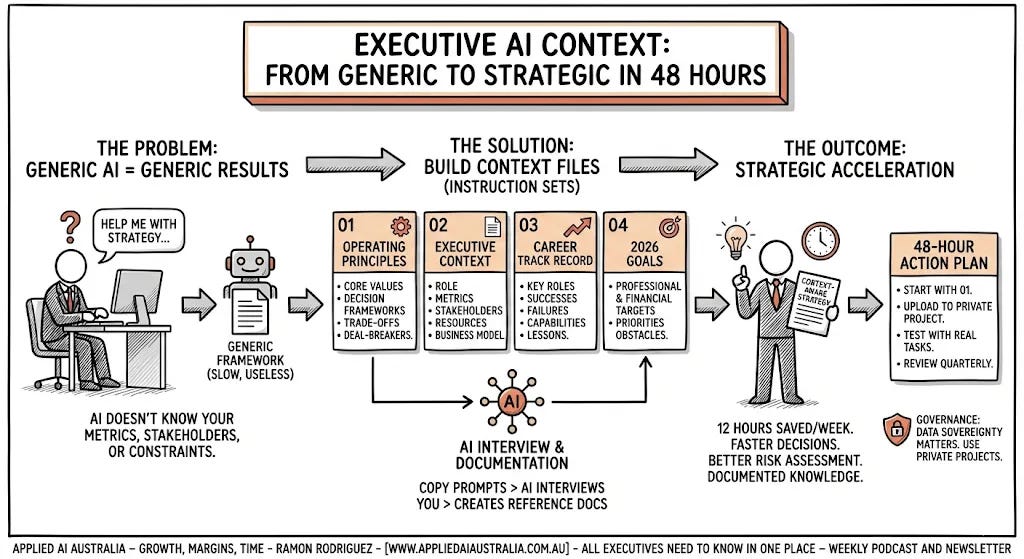
Governance
Data sovereignty matters. Before uploading anything sensitive:
Use temporary chats or Enterprise accounts. Consumer ChatGPT (or similar) Projects don’t reliably isolate data even with “project-only memory” enabled.
Check your organisation’s AI policy. Many Australian firms now restrict what can be uploaded to third-party AI.
Know where data goes. OpenAI processes through US infrastructure. For regulated industries (financial services, healthcare, legal), this may breach OAIC requirements.
Under Australia’s emerging AI governance standards (VAISS, Privacy Act), boards need to document where sensitive business data is processed. If you’re uploading stakeholder relationships, financial constraints, and performance metrics, that’s board-level information.
The Bottom Line
Another exec used this to document a retiring GM’s 20-year knowledge base before they left. Captured decision patterns, stakeholder relationships, operational trade-offs.
New GM went from 4 months to full capability in 8 weeks.
The difference between AI that saves 20 minutes and AI that changes how you work is context. Generic AI gives generic advice. Context-aware AI gives your advice: faster, documented, repeatable.
The CFO math: 12 hours per week = 48 hours per month = 1.2 FTE at exec salary (~$15K/month value).
48-Hour Action
Pick one prompt. Start with Operating Principles.
Copy. Paste. Answer the questions. Upload. Run three real tasks. Compare output quality.
If difference is marginal, context is too generic. If output makes you uncomfortable because it’s accurate, you built it right.
Subscribe to Applied AI Australia
All you need to know in one place, specifically for Australian Executives and Organisational leaders. Frameworks you can apply in 48 hours.
Podcast: Subscribe on Apple Podcasts | Spotify
About
We specialise in translating AI complexity into strategy that drives business outcomes, Australian executives can act on with confidence. We deliver executable frameworks, board-ready playbooks, and strategy designed for Australian enterprises.